

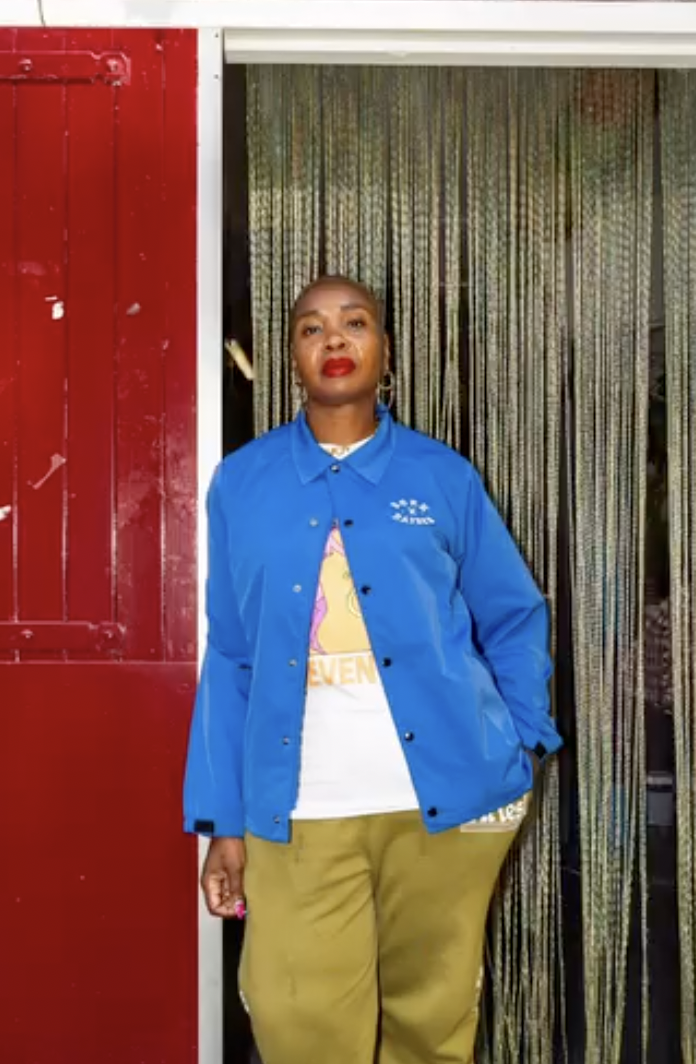
If you drop the name Angie B in Amsterdam Southeast, everyone knows who you're talking about.
She has become one of the most sought after chefs in the city, earning her stripes by simply staying true to herself. This is a Chef who doesn't have to conform to a standard or framework in which chefs are "supposed" to cook. This has led her to a career where she can stick to whatever she feels is right. She has crafted her own lane and has been able to use social media effectively. It solidified her name around town as her food proved to be just as good as the beautiful images she posted on Instagram. It became part of her signature and helped her build a loyal customer base who all trust Chef’s food. Within a short period of time, she also had to trade her home kitchen for a commercial space to be able to keep up with the increase in clients and orders. This new working space would not only expand her business, it would bring her back to where it all started as she returned home to the Bijlmer; where it all began.
Chef Angie B landed right in the community of a neighbourhood farm in Gliphoeve between the Geldershoofd apartment building and Ganzenhoef subway station (behind the shopping center). Her kitchen is the pancake restaurant located at the center of the farm grounds. It is here where she educates young people with learning disabilities and simultaneously runs her business, offering a unique combination of pancakes, Surinamese sandwiches, and drinks during the week and a varied menu of Surinamese cuisine during weekends. The kitchen is incredibly busy, attracting people from all over Amsterdam and surrounding areas, all coming through to pick up food or sit at the table. Right in the middle of the kitchen, where chef mostly does everything by herself and sometimes also assisted by her students. And even though she gained a reputation in the city within a short time span, her process prior to becoming a household name took time and was certainly not solely due to a successful Instagram account. Chef Angie’s journey involves a long path of self-discovery and personal transformation to get where she is today.
Angela Benjamin grew up with a grandmother who was the family chef. She lived three floors up in the same building in Kleiburg/Kraaiennest.
"Angela, come see what I'm doing."
She always called me to come up, so I happily trotted from the 6th to the 9th floor. I don't remember how old I was, but I was small enough for Grandma to put me on the kitchen counter. She would then cook and insist that I learn how to make different dishes. How something should taste, how it should smell, how it should feel on the tongue, I had to learn all of it. Sitting on the counter, watching her prepare the most delicious Surinamese dishes, I either listened to her storytelling or her singing voice. She would sing all the time and she also had a beautiful voice. As I’m learning under her wing I am yet to realize that in this kitchen my Grandmother was laying the foundation for what was to come later in life.
And so, she has given me the most beautiful memories, and as I look back at how she taught me life lessons in such a pleasant way from that counter in that kitchen. I feel truly grateful for the experiences.
When I was eleven, I first realized that cooking actually did appeal to me. In an attempt to alleviate my mother between work and the household responsibilities I decided I would fix her a Chinese Tayersoup. It was one of the dishes Grandma made often and I had remembered it quite well. When my mother came home from work and started eating the soup, she kept asking who made it. She couldn't believe that I had made that soup and was completely blown away by the taste. I was proud of myself and experienced for the first time a moment where I felt like cooking could actually be my thing.
However, I also come from a family where studying is very important, and my Grandmother was very much about education. She would say, "Your Paper is your partner." So as I got older, I went to college and chose to study in Banking and Insurance.
I was very achievement-oriented, but it was, of course, a very boring study. Then everything changed when my mother had a medical complication and I had to take on the responsibility to care for her. It is at this time that I decided to let go of everything I was doing.
The situation at home was not just a response to the crisis, it brought me to the realization that I was not doing what I wanted to do, which was cooking.
By now I am 23 and decided to go to cooking school. During my education, I learned all the techniques and principles of cooking. Being in cooking school taught me a lot about Eurocentric practices and methods, followed by the many places I worked at that taught me even more about European cuisine. Yet I knew that these places didn't give me the feeling that your heart and soul are intertwined. Once again, I had to make the conscious decision to do what fits me and so I asked myself, what kind of chef do you actually want to be? And then the pandemic hit.
Like many, I ended up sitting at home, which also drove me crazy. I really wanted to cook but couldn't, until one day when I decided, I'm just going to cook here at home and give people the option to pick up. I did this every Saturday and from the moment I started, it brought me back to who I am and where I came from. The lessons I learned from my Grandmother and the realization that Surinamese food is what I am good at and my culture is my strength. It was a defining time and I decided to stick to my roots.
Combining the classic chef training with my own cultural background, I gradually cultivated my own cooking style and signature dishes. Fundamentally traditional Surinamese but with a twist. I also consciously choose to cook large portions. My thinking is that one should be able to eat for two days or be able to share your food with someone else; that's also very Surinamese. And perhaps the most important thing about creating a menu was to NOT create a menu and cook what I feel.
I've had to work in traditional kitchens for years with a set menu or menus that are seasonal, but even those come back each season or remain in season for six months. I couldn't stand it.
To me there is no way you can put your heart into the same thing every day, and I know that I can't make bami for you every day. That bami will be nice once, but if I have to do it every day, it won't be so nice anymore. So I knew that in order to maintain my standard of cooking high, I needed the freedom to do it from a holistic approach which means I would cook something different every day.
I experience that people have certain expectations of Surinamese chefs, that we're supposed to cook the typical, commonly occurring dishes. I therefore also had to educate my clients which took a while, but what I got in return is that people followed me and eventually trusted my instinct. So if I say we're eating pom this weekend, everyone goes along with it and the compromise is, we're eating pom this weekend.
The beauty is that with this trust, my clients also give me confidence. Because they know what I can do and I know it's okay to trust my gut. I go as far as to say that if I don't feel it, I won't do it. Then I just take a break or I don't cook. And this is where Grandma comes back into the picture and who knows, finds herself on my kitchen counter and guides me, as I believe my ancestors very much do, guide and carry me in everything I do. My grandma's lessons were mainly spiritual and her cooking was based on feeling, so I know that I also have to guard my spirit to do my work well. And if this means that I have to withdraw and sit in my own space, not answer my phone, or just be alone for a while. It is this way that I am able to claim my own space and create a world where I, as Chef Angie B, can experience total freedom.
On Keti Koti
Keti Koti, the commemoration and celebration of the abolition of slavery, was not something that was confined to just one day in my family. Our history and where we come from has always been a part of our lives. The awareness and the traditions and rituals that exist in my family are always present. I also pass this on to my children. They are already at an age where they understand and grasp a lot, but also ask many questions. So, a certain awareness lives within them, and we always take the day off on July 1st.