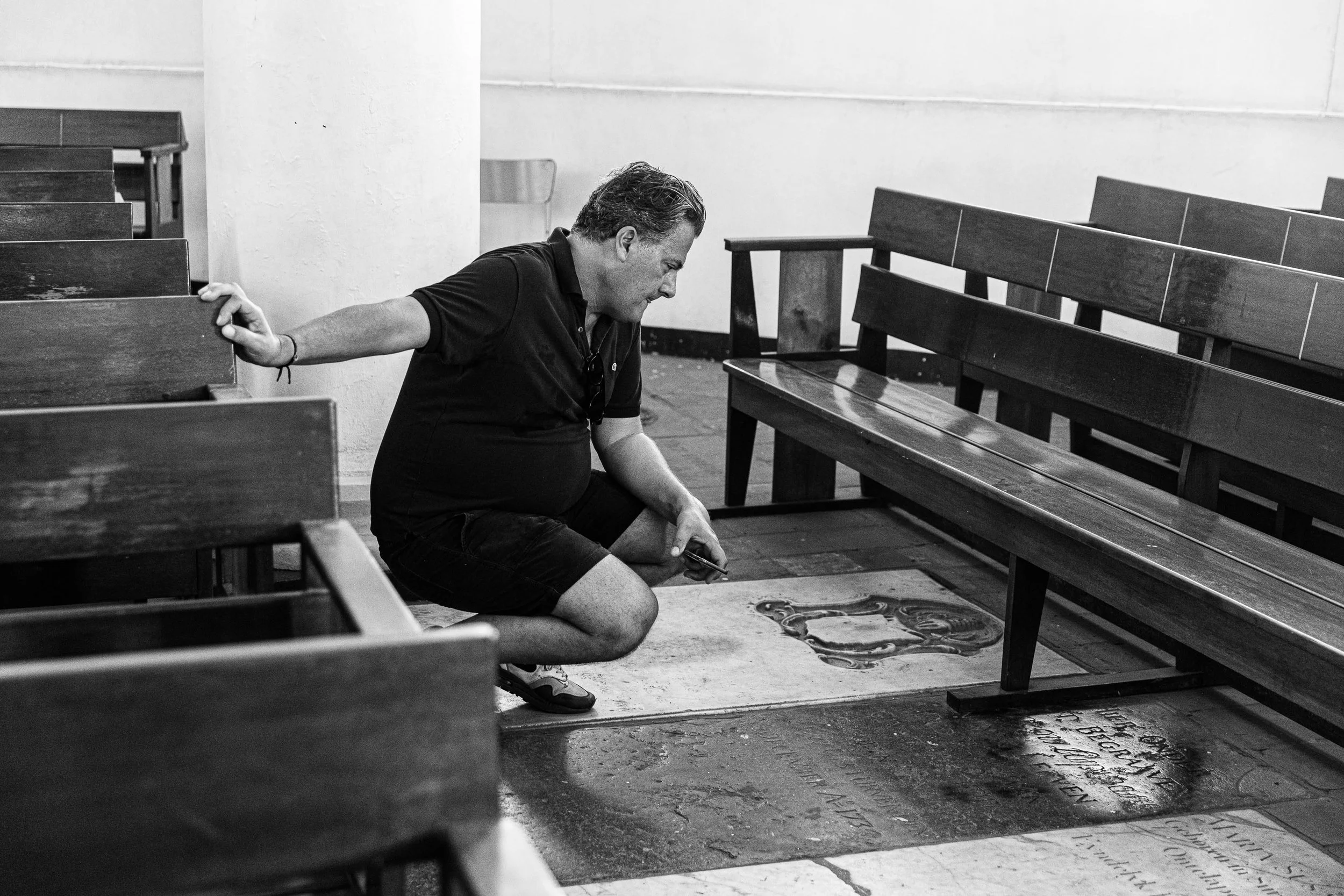
Gijs Stork: Confronting a Family History of Slavery
Together with art collector, cultural facilitator, and author Gijs Stork, we trace the family history of his ancestors—Portuguese Jews and French Huguenots who fled religious persecution in France and settled in the Netherlands during the seventeenth century. Families such as L'Espinasse and Taunay were later granted permission to establish themselves in Suriname, where they became colonial plantation owners.
Captivated by his own family history, Stork decides to travel to Suriname himself, hoping to experience the country firsthand and to imagine—and better understand—the world his ancestors entered centuries ago.
"My ancestor, L'Espinasse, was the first to travel from Amsterdam to Suriname. One of the L'Espinasse daughters later married Jean Paul Taunay, and together they founded Plantation 't Vertrouwen.
Plantation 't Vertrouwen was a sugar plantation situated along the Cottica River in the Commewijne district of Suriname. Sailing upstream, it was located on the left bank, downstream from Plantation Mon Souci and upstream from Plantation Campenburg. Both plantations later also came into the possession of the Taunay family and remained family property even after the abolition of slavery.
For Stork, it is difficult to comprehend that his ancestors—who themselves had been persecuted as Huguenots and Jews in Europe—became colonists in Suriname within the span of a single generation.
"It raised a fundamental question for me: where do your own notions of good and evil begin and end?"
Upon arriving in Suriname, Stork immediately visits the site of Plantation 't Vertrouwen. Sadly, almost nothing remains. The only visible traces are a stone staircase and several bricks known to have been fired in Amsterdam. These bricks had been transported across the Atlantic as ballast aboard Dutch ships. Once they reached Suriname, enslaved Africans used them to construct sluices, houses, and other plantation infrastructure.
For Stork, the discovery was deeply moving. Realising that these bricks dated back to the colonial era made the history of his ancestors suddenly tangible.
"I went to Suriname because I had decided that, as a descendant of a slave owner, I wanted to make this history real and tangible for myself. When I hear people say that they have nothing to do with it, or that it all happened so long ago, I often think that they are avoiding their own history. There are many reasons why people might do that, but I felt that by confronting this history in a concrete way, I could contribute to telling the whole story. It also helped me personally to process certain aspects of this history and to better understand how its legacy has continued to shape my own family. I'm referring to the sense of normalcy—the system that has long made privilege seem self-evident for us as white people. Not only within my own family, but throughout society, we're now seeing more and more people questioning that system."
When asked what others can learn from his journey, Stork replies: "Explore your own history. Listen to other people's stories, and don't be afraid to do so. Simply recognize that there are people with different experiences, and that history has shown us we are capable of making a new beginning together."
Stork managed to bring one of those Amsterdam bricks back from Suriname. It has made a remarkable journey: first shipped from Amsterdam to Suriname to help build the wealth of the colony, and then returned to Amsterdam centuries later as an object that symbolizes a tangible connection to the past.
When asked, as a collector, what his favorite object is, Stork doesn't hesitate. “The brick. It's the only object in my home that is a tangible piece of history. To me, it is the most powerful symbol of how hidden stories can come together in unexpected ways."
His final message is a simple but meaningful invitation: "Use July 1st as an opportunity to learn more about this history and become more aware of it. Not only to understand what happened, but also to connect with one another."